
FOR PARENTS OF STUDENTS
Is It Defiance?
Or Is Their Brain Still on Summer Vacation?
Planning, follow-through, and self-control are learnable skills, not personality traits. Here's how to help your child get back into rhythm this school year.
Want to learn more about our sessions?
Scroll down to see how we help your child go from summer vacation to school-ready. ↓
What Is Executive Function?
Get points by clicking! Watch both videos below and earn 10 points for each one.
 Part 1
What Is Executive Function? — Part 1
Click to watch on YouTube
 Part 2
What Is Executive Function? — Part 2
Click to watch on YouTube
11 Executive Function Skills Your Child Needs
Click through the modules below and complete this course by watching every video to learn how to put these strategies into practice. Earn up to 10 PBIS points for each video you watch, and complete both Part 1 and Part 2 to earn the maximum number of points.
YOU'RE NOT IMAGINING IT
There's a Reason for the Meltdowns
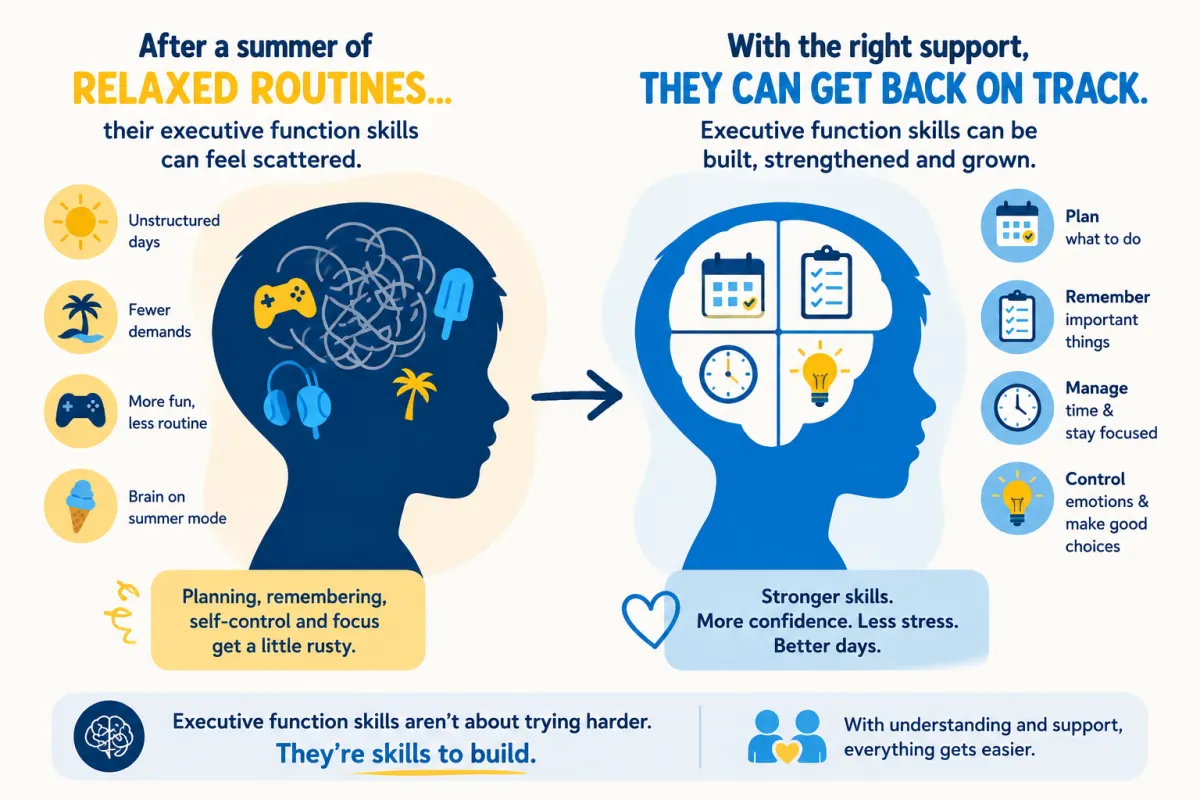
Executive function is like your child’s brain’s “air traffic control system.” It helps them plan, remember what they need to do, manage their emotions, and stay in control.
After a summer of relaxed routines and fewer demands, jumping back into a structured school schedule can put those skills to the test.
everything gets easier:
Myth: "They just need to try harder."
Reality: These are trainable brain skills, not a motivation problem.
Myth: "Good kids don't struggle with this."
Reality: Even bright, capable kids can have executive function gaps.
Myth: "This means I'm doing something wrong as a parent."
Reality: It's brain development, and it's fixable with the right support.
THE COMPREHENSIVE PATH FORWARD
Give Your Child the Tools to Thrive
by Joining Our Sessions.
Parenting is harder than ever. Helping your child thrive takes more than love and good intentions. It takes a deeper understanding of your child and the right tools to support them at home and in school.
Interested in what you learned in these modules? Sign up to attend one of our sessions, where we’ll dive deeper into practical tools you can implement at home that can make a difference in your child’s success at school.
This course is a sneak peak at what you’ll discover when you join our sessions.You don't have to figure this out alone, and you don't have to piece it together from a checklist. In these sessions you'll sit down with other parents who get it. Learn exactly what's happening in your child's developing brain, and walk away with real tools you can use in your home tonight, not someday.
Session Spotlight: Temperament and Individual Differences: understand the wiring your child was born with, so you stop comparing them to a sibling or a "should."
Session Spotlight: Relationships and Parenting Styles: See how your everyday responses shape your child's sense of safety, and walk away with a style that fits your family, not a stranger's rulebook.
Session Spotlight: Smartphones, Screens, and Attention: Get a straight answer on how screen time is really affecting focus, and a plan for boundaries that don't turn into daily battles.
Session Spotlight: Circadian Rhythms, Sleep, and Mood: Learn why an overtired brain looks exactly like a defiant one, and simple routine shifts that protect both sleep and temper.
Session Spotlight: Dopamine, Reward, and Motivation: Discover why "just try harder" never worked, and how to build motivation systems that actually match how your child's brain gets things done.
Parent Session Sign-Up
Give your child the tools to succeed, earn 25 PBIS points for attendance, and join us for a weekly brunch on us!
Join us to learn more about your child, discover strategies that work, and connect with other parents. Let your principal know if you would like to join one of our sessions. This is just a small glimpse of what you’ll learn in our session.